
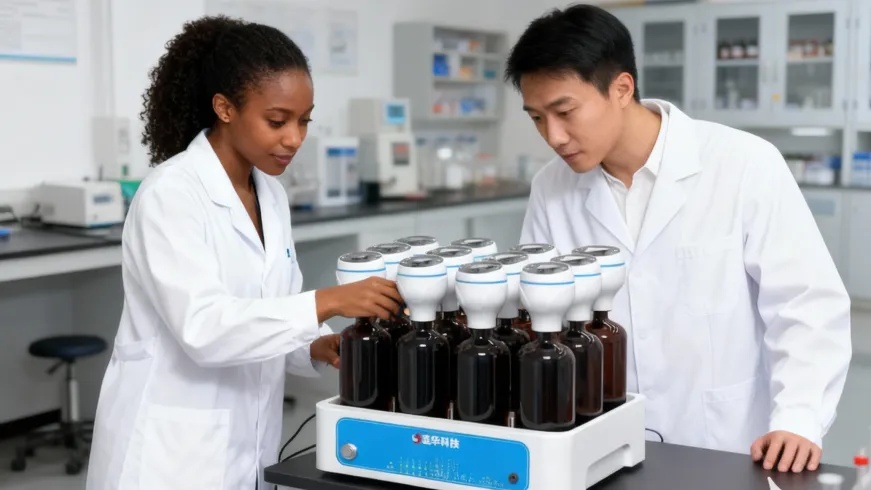
BOD (Biochemical Oxygen Demand) is a key indicator for measuring the amount of oxygen consumed by microorganisms when decomposing organic pollutants in water. Have you encountered various problems when conducting BOD5 experiments? We have collected some common questions and provided concise answers to help you complete each test more smoothly.
Q1: What are the steps for BOD5 testing?
A: Before testing, it is necessary to determine whether the sample contains microorganisms. If it contains aerobic microorganisms, it can be tested directly; if it does not contain aerobic microorganisms, the sample needs to be inoculated before testing. The test requires a specific temperature for the sample, so after removing the sample, it needs to be placed in a constant temperature incubator to maintain a temperature of approximately 20 degrees Celsius. Nutrients (3 ml/L) and buffer (1 ml/L) should be added to the sample to enhance the activity of aerobic microorganisms. Before sampling and testing, the pH of the sample needs to be adjusted to between 6.7 and 7.5 (ideally 7.2). After completing the above preparations, estimate the sample’s BOD range based on 60% of the sample’s COD value. Then, using the corresponding table provided with the instrument (which shows the approximate BOD detection range and corresponding sample volume), measure the sample volume according to the corresponding detection range and sample volume. Transfer the sample to a culture flask, add a stir bar, and fill the reagent cup with the absorbent. Follow the accompanying operating instructions.
Q2: When using the mercury-free differential pressure method to measure the BOD standard, the values are often low. What could be the reason?
A: If the BOD levels are consistently low when using the provided bacterial strain, we suggest checking the following: First, when preparing the BOD standard solution, be sure to use superimposed pure glucose-glutamic acid. Before preparation, the glucose-glutamic acid needs to be dried (to about 100°C), weighed accurately, and stirred thoroughly when adding water to ensure complete dissolution. Then add 3ml of nutrient salts, 1ml of buffer solution, and 10-15ml of the cultured bacterial strain. After bringing the volume to approximately 2cm from the mark, adjust the pH to between 6.7 and 7.5 (ideally 7.2). We recommend using the precision pH test paper provided with the instrument. Finally, bring the volume to 1000ml. Always refer to the table provided with the instrument, which indicates the corresponding sampling volume. Sampling must be accurate, and care must be taken not to spill when transferring to the culture bottle. When assembling and tightening the cap, ensure sufficient absorbent granules are added to the reagent cup, but do not allow absorbent to fall into the sample in the culture bottle. Make sure the cap is tightly sealed to prevent air leakage! For wired BOD equipment, ensure there are no poor connections and that data transmission is smooth. The culture flask cap self-test is normal, and the instrument parameters are normal.
Q3: What if the culture flask wall is difficult to clean?
A: The culture flask wall may have some flocculent material produced by microorganisms that is difficult to clean. It is recommended to gently brush the flask wall with a long-bristled brush, then rinse thoroughly with plenty of tap water, and finally rinse several times with pure water.
Q4: How often should a standard sample be prepared for BOD5?
A: There is no fixed standard. If you feel the measurement is inaccurate, the instrument has not been used for a long time, or the operator has changed, you can prepare a standard sample for verification.
Q5: The BOD value is zero after five days. Is the detection incorrect?
A: Our instrument will detect a value every day during the 5-day testing period. If you get 0 every day, one possibility is that the sample does not contain microorganisms; another possibility is that the cap is not tightened, causing a leak.
Q6: How to prepare the BOD inoculum?
A: Generally, first take a certain amount of water sample, then add 10-20 ml of bacterial inoculum. The inoculum is usually a water sample rich in aerobic microorganisms and with a very low BOD concentration. (Add less in summer and more in winter depending on the temperature). Add 3 ml of nutrients (salts necessary for microbial survival) to every 1 L of water, and then add 1 ml of buffer solution (to prevent sudden increases or decreases in pH that could affect the microorganisms). Then dilute the water sample to 1 L and aerate thoroughly. This water sample is the diluted inoculum solution, which is used for diluting the sample.
Q7: How to detect residual chlorine and bound chlorine in water samples?
A: If the sample contains a small amount of residual chlorine, the free chlorine will disappear after 1-2 hours of standing. For residual chlorine that does not disappear quickly, an appropriate amount of sodium sulfite solution can be added to remove the residual chlorine and bound chlorine present in the sample.
Post time: May-14-2026


